Nothing common rhymes with have. It is the 26th most common word in English. Its one true rhyme is calve, what a cow or a glacier does. The standard pronouncing dictionary leaves it out. Halve doesn't count. It sounds just like have, start to finish. Poets call that an identity rhyme and don't count it.
Month has no rhyme either. Nor do film, golf and depth. Nor, famously, do orange and silver.
To rhyme, two words must sound the same from the last stressed vowel to the end. Day and way rhyme. So do sing and ring. Words that share a rhyme form a rhyme family: day, way, say and play are one family. Fig. 1 lists the 25 commonest words that end on a stress and have no rhyme.1 The second column spells each word's rhyme in CMUdict's sound code: ae is the vowel of cat, ah the vowel of sun, th the sound at the end of bath. Each bar shows how close the word comes to a near-rhyme.
To measure "close," line up two rhymes sound by sound and charge for each difference. The more alike two sounds are, the less a swap costs. Month and once swap th for s, two hissing sounds: 0.12. Film and kiln swap m, made with the lips, for n, made with the tongue: 0.36.2 Adding a whole extra consonant costs more, 0.6. A perfect rhyme costs nothing.3 I chose these prices by hand rather than fitting them to data, so the order of the bars means more than their lengths.
Else nearly rhymes with sense. Whilst has to stretch all the way to Christ.
In silver, the weight falls on SIL. That is the stress.
A rhyme starts at the last stressed vowel and runs to the end of the word. Day rhymes on -ay. Silver rhymes on -ilver. Family rhymes on -amily.
Every sound in that stretch must match. Each extra sound is one more chance to find no partner. English adds sounds in two ways. It puts syllables after the stress, and it piles consonants at the end.
The syllables matter most. Fig. 2 sorts English words into three shapes: words that end on the stress, words with one weak syllable after it, and words with two or more. Each grid stands for all the words with that shape, and each orange square is one percent of them with no rhyme.
Words that end on the stress almost always rhyme: one square in a hundred is orange. With one weak syllable after the stress, a fifth of the grid turns orange. With two or more, nearly two-thirds does.
English likes to stress early. Two in three two-syllable words are stressed on the first syllable, like silver and orange. That drags a whole extra syllable into the rhyme.
A thought experiment shows where the trouble lies. Suppose every rhyme started at the last vowel, stressed or not. No poet would accept that rule, since it lets orange rhyme with challenge. Under it, silver rhymes with more than a thousand common words, never and over among them. Month rhymes with seventh. The share of English words with no rhyme falls from 24% to 1%.4 The trouble is the unstressed stretch after the stress.
Film and depth still have nothing, even under that rule. Their trouble is the consonants at the end. Fig. 3 sorts English words with one-syllable rhymes by how many consonants follow the vowel. Each grid stands for all the words with that many, and each orange square is one percent of them with no rhyme.
With one final consonant or none, almost every word rhymes. Each added consonant turns more of the grid orange. With four, nearly half the words have no rhyme, though English has only fifteen such words, like texts and strengths. Month is alone with its ending: the vowel of sun, then n, then th.
This also explains a puzzle. Common words rhyme more often than rare ones. Only 12% of the top thousand words have no rhyme. Among rare words, about a quarter don't. One might hypothesize that the more a word is used, the more partners it collects, but it doesn't. Fig. 4 splits the words by how long their rhyme is: one syllable like day, two like silver, three or more like family.
The dark lines are nearly flat. At any one rhyme length, common and rare words rhyme about equally well. Common words are just shorter. Most of them end on a stress.
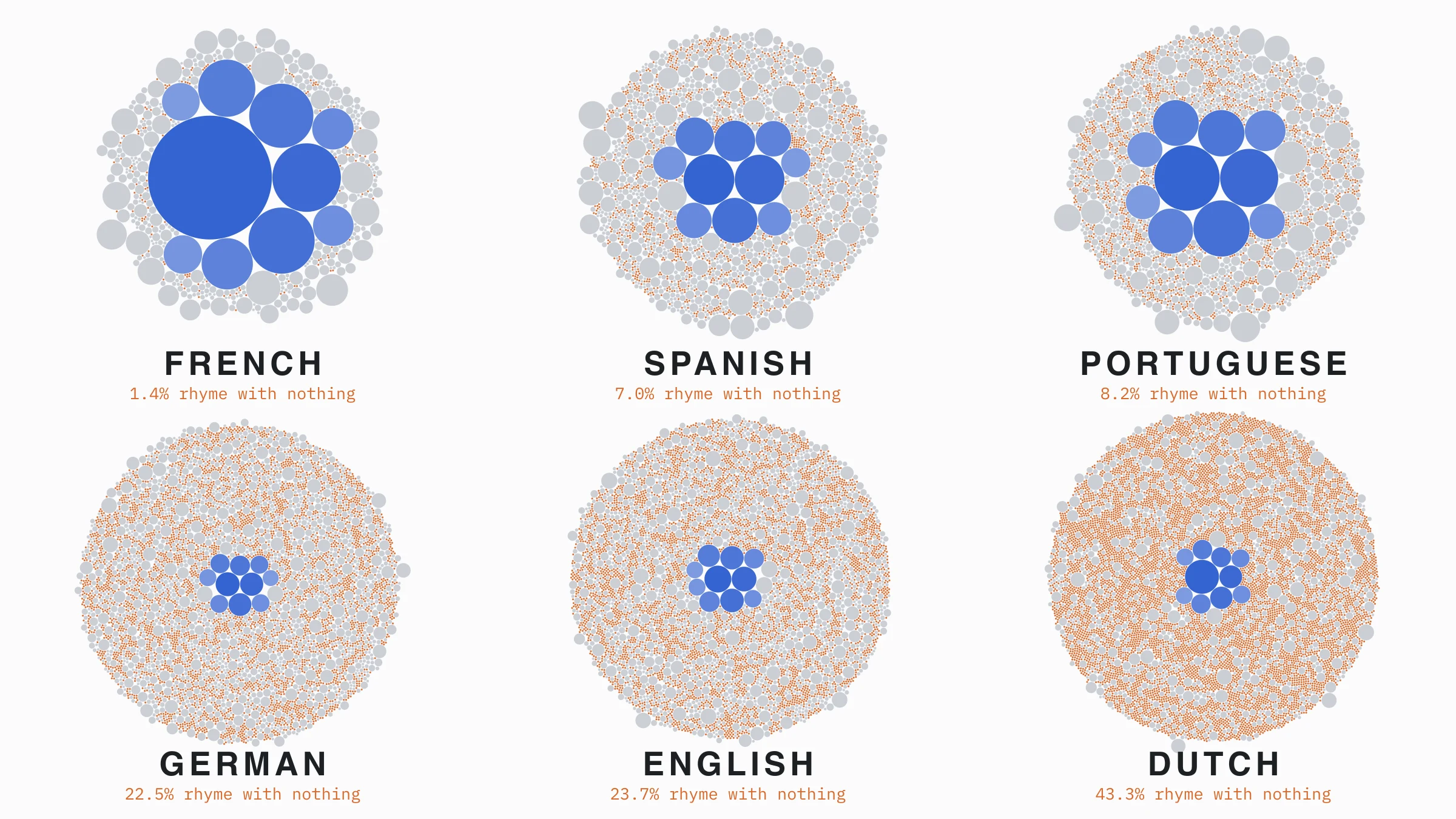
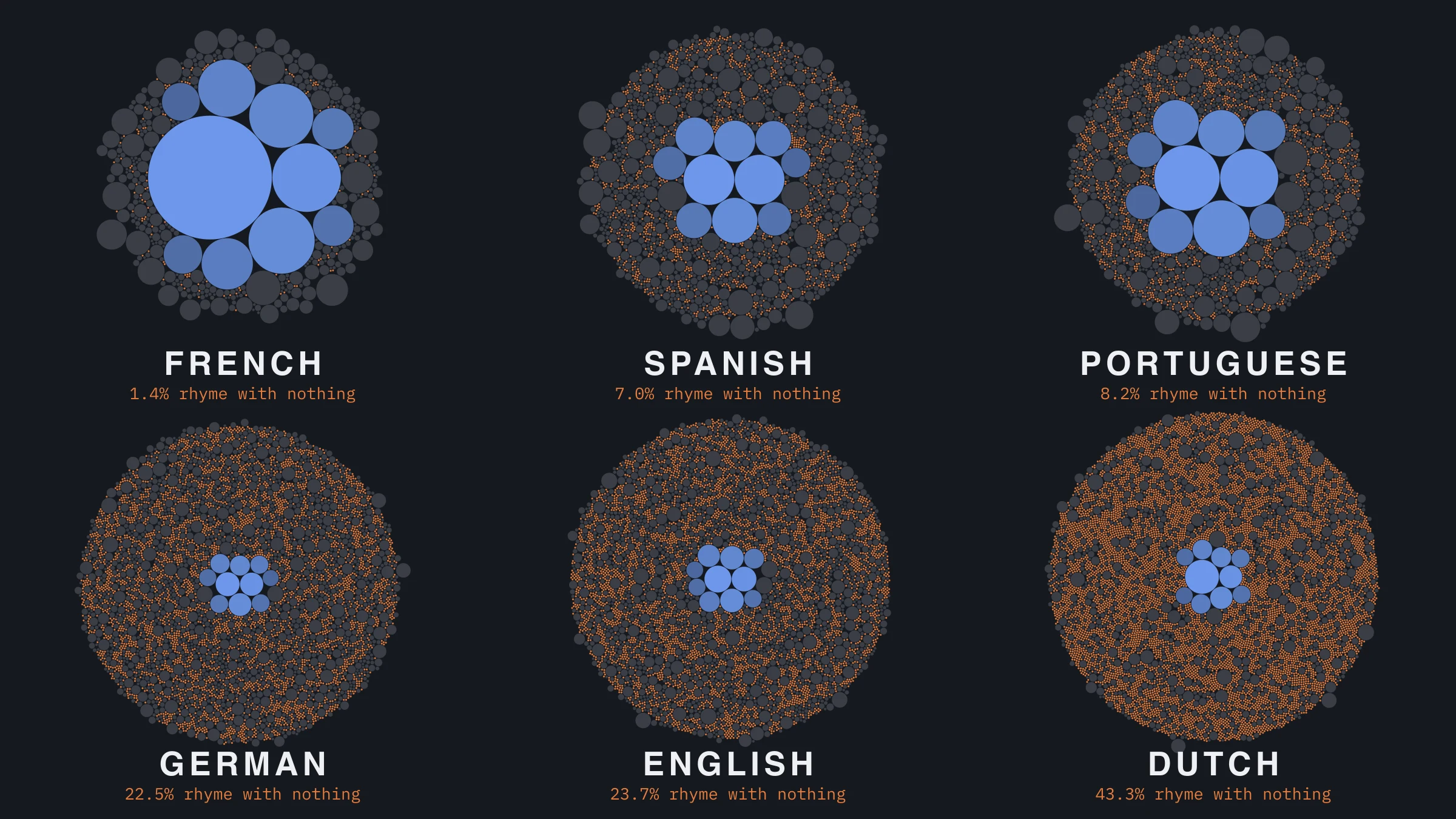
If the syllables after the stress are what leave words without rhymes, languages that stress differently should rhyme differently. They do. Fig. 5 runs the same count on the 20,000 commonest words of six languages, as counted in film and TV subtitles.5
English sits with German and Dutch. About a quarter of English and German words have no rhyme. Dutch leaves even more alone. In Spanish and Portuguese, fewer than one in ten are alone.
French barely registers. It doesn't stress words the way English does. Its accent falls at the end, so every French rhyme is one syllable long. French words are 1.4% alone. English words that end on a stress are 1.3% alone.
Spanish rhymes are often two syllables long. Yet only 6% of those Spanish words lack a partner. In English, 34% do. Part of the reason is sound. English words end in many more different ways than Spanish words do. Spread across more endings, the same 20,000 words leave fewer for each.6 The bigger reason is what the stress lands on. In Spanish ha-BLAR, "to speak," the stress falls on ‑ar, an ending hundreds of verbs share. In English SIL-ver, it falls on silv-, a piece that belongs to that word alone. Fig. 6 lines up each language's words in rhyme families, biggest first.7
The difference is plain in the blue. Spanish and Portuguese start with wide blocks. English starts with slivers.
The widest Spanish block is ‑ar. It holds 728 words, and at least four in five are verbs in their infinitive form.8 Every such verb rhymes with every other. Grammar supplies the rhymes.
English stresses the root of a word: SIL-ver, OR-ange. Unrelated words rarely share a stressed root, so silver and orange each stand alone.
English has endings that repeat too, the ones grammar adds: walking, faster. ‑ing and ‑er each cover more than a thousand common words. But English doesn't stress them, so they never start a rhyme. German and Dutch work the same way. Their endings, like ‑en, are unstressed too.
English rhymes are rare. They are also lopsided. Most rhyme families (65%) hold a single word, so they aren't very useful. The hundred biggest hold a quarter of all words. Fig. 7 shows the curve, and where three poets draw their rhymes from it.9 The top panel runs from a few huge families to a long tail of tiny ones. Both of its axes are on a log scale. Alexander Pope translated Homer's Iliad in the early 1700s in couplets. Shakespeare's Sonnets are 154 short poems; the 152 with the usual fourteen lines are counted here. Lord Byron's Don Juan is a long comic poem, written 1819–1824, in eight-line stanzas.
The poets live in those hundred families. Pope takes two-thirds of his rhymes from them. Shakespeare takes more than half. Byron, the loosest, takes a little under half. Even he takes twice the dictionary's share.
Pope's rhymes are narrow next to the rest of his language. Fig. 8 counts the rhyme families a poet uses. It compares the words at the ends of his lines with the words inside them.
No rhymed poem can use as many families as its other words do, since every family it uses must appear at least twice, so the order of the poets matters more than the absolute numbers. Over the whole Iliad, Pope's line ends use 268 rhyme families. The words inside his lines reach 1,745. That comparison is unfair to a short poem, so panel (b) puts all three poets at the same length, 2,045 words. There, Pope's rhymes reach a quarter as many families as his other words. Shakespeare's reach half, and Byron's nearly three quarters.
The other way out is to bend the rule. Two more poets join the comparison here, both published in the 1890s. A. E. Housman, an Englishman, wrote plain, regular ballads in A Shropshire Lad, rhymed cleanly. Emily Dickinson, an American, bent rhyme on purpose and often. Fig. 9 uses the same sound-by-sound cost to measure how far each poet's rhyme pairs stray from perfect.10 One caution first: it judges every poet by modern American speech. That is wrong for the older poets, and for Housman, who was English; his been and queen rhyme in his own accent.
The orange bars are pairs spelled alike but said differently today, like love and prove. Some were eye rhymes from the start. Others rhymed once, before English evolved, but our data can't tell which.
Housman, in 1896, strays in 5% of his pairs. Dickinson, published in the same decade, strays in 47%. Often she keeps the consonants and lets the vowel go. Her editors smoothed some of these out, so the true share is likely higher.
Spanish grammar hands its poets hundreds of verbs that rhyme on -ar. English gave Pope plain, slain and vain. He went back to them 583 times.
None of this makes English a worse language for poetry. Scarcity sets the terms, and each poet answers it differently. Pope returns to the same few chimes, Dickinson lets the vowels drift, and Byron turns the rare long rhyme into a joke, pairing ladies intellectual with hen-peck'd you all.
Pronunciations are from CMUdict, modern US English, restricted to the 51,885 entries that are ordinary words (a lowercase WordNet lemma or a Webster's 2nd entry); rank is position in Norvig's Google web unigram counts, and candidates are lemmas in the top 40,000. Identity rhymes (have/halve) and compounds (quicksilver) don't count as partners. Orange, silver and purple have no partner either; Webster's 2nd lists sporange, chilver and hirple, which CMUdict lacks. In all, 104 of 10,026 common words with a one-syllable rhyme have no perfect partner. Two partner labels were replaced by the next word. Three entries are artifacts of the dictionary: walsh is mostly a surname, wont is alone only because don't is filtered as a contraction, and alt because CMUdict gives halt a different vowel.
↩To hear and feel where in the mouth sounds are made, play with Pink Trombone, Neil Thapen's interactive model of the human vocal tract.
↩The full price list. A consonant swap costs up to about 1, by how far apart the two sounds are made in the mouth (lips, teeth, the ridge behind the teeth, the back of the mouth), how they are made (a stop like t, a hiss like s, a hum like n), and whether the voice buzzes (v buzzes, f doesn't; a buzz difference adds 0.25). So else/sense (l for n) costs 0.08, have/as (v for z) 0.24, ninth/lines (th for a buzzing z) 0.37. Vowels are priced by where the tongue sits, and the stressed vowel counts half again as much. Adding or dropping a consonant costs 0.6, a syllable 1.5.
↩English falls from 23.7% to 1.2%, Dutch from 43% to 0.6%, German from 22.5% to 1.6%, Portuguese from 8.2% to 0.1%, Spanish from 7.0% to 0.1%. Silver gains 1,068 partners among the 20,000 commonest words. Same 20,000 words per language and same partner rule as Fig. 5, with the rhyme taken from the last vowel instead of the last stressed vowel. This is a diagnostic, not a model of moving stress: pronunciations, reduced vowels included, stay fixed, and only the place where matching starts moves. Taking the last vowel alone, dropping the consonants after it, leaves under 0.05% of words in any language without a partner.
↩Pronunciations from ipa-dict, frequencies from OpenSubtitles 2018, so the vocabularies lean toward film and TV dialogue. Spanish stress is filled in from spelling where ipa-dict leaves it unmarked; Spanish spelling marks stress without exception. Dutch marks no secondary stress, which lengthens the rhymes of its compounds. Italian is absent because no open dictionary with stress marks was available. On the same 20,000 English words, the CMUdict machinery gives 24.3% rhymeless against ipa-dict's 23.7%.
↩Counted from the last vowel, English has 1,032 distinct rhymes among its 20,000 commonest words and Spanish has 57; English's -ing family holds 1,196 words and -er 1,105.
↩"Alone" is close to, but not the same as, rhymeless: each word is counted once, under its first listed pronunciation, and identity rhymes count as family members. Families narrower than 1.5 px are merged by size. The top 10 families hold 22% of Spanish and 32% of Portuguese words, against 7% of English.
↩A word in the family counts as a verb form if another form of its stem (-ado, -ando, -amos, -aba and so on) is also among the 20,000 words: 575 of 729 Spanish -ar words (the rest are words like lugar, place, and militar), 548 of 698 -ado words, and 881 of 1,206 Portuguese -ar words. The test misses rare verbs whose other forms aren't common (competir), so the shares are lower bounds.
↩Texts from Project Gutenberg: Pope's Iliad (5,729 couplets, 11,199 rhyme words), Shakespeare's Sonnets (152, excluding 99 and 126, which are not 14 lines; 2,045 rhyme words), Byron's Don Juan (1,975 stanzas, 14,544 rhyme words). Pope takes 66% of his rhyme words from the top 100 families, Shakespeare 57%, Byron 47%, against 24% of the dictionary. Each line end counts once; words missing from CMUdict are dropped. Mid-line words are every word of a line except the last, with NLTK English stopwords removed.
↩Dickinson: Poems, 1890–96 Todd and Higginson editions, 878 pairs from lines 2 and 4 of 1,029 four-line stanzas. Housman: A Shropshire Lad, 1896, 266 pairs. In 23% of Dickinson's pairs only the vowel differs, counting pairs not already spelled alike, against 1.5–6.4% for the others. Shakespeare 19% imperfect (993 pairs), Pope 13% (5,471), Byron 22% (8,465). Pairs with a word missing from CMUdict were dropped: 71 / 258 / 1,410 / 151 / 19. Distances run higher than in Fig. 1, whose bars measure one word to its nearest family, because these pairs can differ in several sounds and in length.
↩